
The EU-wide rollout of the EUDI Wallet is often discussed as a digital wallet for citizens, but for the German economy, it is a strategic infrastructure project with transformative potential—driven by the federal government and initiatives such as SPRIND (Federal Agency for Breakthrough Innovations). As part of the modernization of the state, it is fundamentally changing how digital identities are verified, certificates are issued, and business processes are designed. This article explains how companies can harness the benefits of the EU-wide wallet solution—from implementation to increasing acceptance among users and citizens.
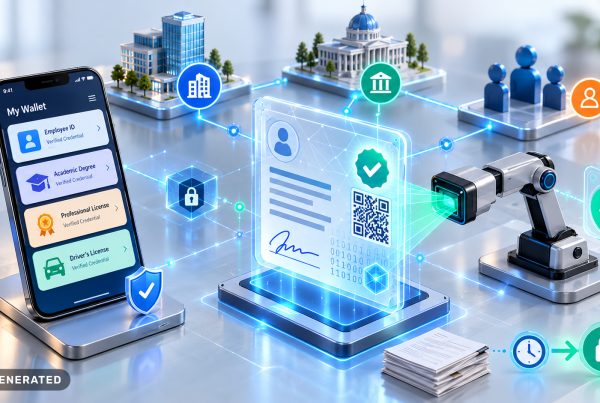
The EUDI Wallet is a European system for digital identities and credentials based on the eIDAS 2.0 legal framework. As a digital wallet on a smartphone, it enables citizens and users to securely store official documents—such as a digital ID card or driver’s license—and present them with a single click when needed. Examples of attributes include age, nationality, driver’s license, or qualifications. The integration of official identification documents, such as the digital ID card and driver’s license, is particularly important.
For the German economy, it is not only the national implementation of d-you that is relevant. Digital services should be prepared to verify wallets and credentials from other EU member states in an interoperable manner. The EUDI wallet establishes a European framework for relying parties and enables:
✅ Greater standardization in processes through uniform data formats
✅ Improved traceability of transactions
✅ Less dependence on individual platform providers
Why eIDAS 2.0 Is Important for Businesses
eIDAS 2.0 (electronic Identification, Authentication, and Trust Services) is the updated version of the European legal framework for digital identities, trust services, and electronic transactions. The regulation establishes binding standards to ensure that digital interactions within the EU are secure, legally sound, and usable across borders. It is a central component of the European digital strategy and lays the foundation for the EUDI Wallet (European Digital Identity Wallet), which will enable citizens and organizations to use their digital identities uniformly throughout the EU in the future.
eIDAS 2.0 enables and regulates:
Legally Binding Electronic Signatures: Electronic signatures have the same legal status as handwritten signatures—regardless of which EU country they are used in. This applies to all types of contracts, from employment contracts and lease agreements to applications submitted to government agencies.
Secure Authentication and Identification: Companies can reliably verify digital identities without relying on physical documents or manual processes. This reduces the risk of fraud and speeds up onboarding processes, such as when opening an account or in e-commerce.
Interoperable certification systems among EU member states: Data and certifications issued in one EU country are recognized in all other member states. This removes previous barriers to cross-border business and services, such as when establishing branches or collaborating with international partners.
Compliance-Conform Digital Processes: eIDAS 2.0 ensures that digital processes meet legal requirements—whether in the financial sector, healthcare, or government services. Companies can rely on the legal validity of their digital transactions and need to devote fewer resources to manual compliance checks.
Trustworthy digital identities for citizens and businesses: With the EUDI Wallet, users gain a secure, self-managed digital identity that they can use for all online services—from filing tax returns to online banking. For businesses, this means they can rely on a standardized, verified identity and no longer need to develop their own identification procedures.
Promoting Innovation and New Business Models: eIDAS 2.0 lays the foundation for new digital services, such as those in the fields of e-health, e-government, and fintech. Organizations can develop innovative solutions based on secure digital identities and trust services—across the entire EU.
Why is this important for businesses?
For the business community, eIDAS 2.0 primarily means legal certainty, efficiency, and competitiveness, making it a central component of the German federal government’s digital strategy. The regulation lays the foundation for Germany’s digital sovereignty within the European context and supports companies in developing innovative business models. Organizations can automate end-to-end digital workflows without having to worry about national peculiarities or legal gray areas. This saves time and money, reduces sources of error, and opens up new markets. At the same time, the regulation strengthens the trust of customers and partners in digital solutions—a decisive factor for the acceptance and success of digital transformation.
Would you like to learn more about eIDAS 2.0? Then feel free to check out our blog post on eIDAS 2.0 readiness.
What Roles Companies Can Play in the EUDI Wallet Ecosystem
Within the EUDI Wallet ecosystem, companies can assume various key roles—depending on their needs and business model:
Verifying Organization (Verifier): Use the wallet to securely and automatically verify digital credentials from customers, employees, or partners—for example, for KYC/KYB processes, onboarding, or access controls.
Issuer: Issue your own digital documents—such as certificates, attestations, or authorizations—that can be stored in the wallet and presented by users as needed.
Service Providers: Integrate wallet features into your own applications to enable digital processes such as contract signing, authentication, or data sharing.
Wallet users (holders): Manage your own digital documents—such as business registrations, certificates, or authorizations—and use them for business transactions.
The EUDI Wallet thus provides you with a self-contained, secure solution that can be used throughout the EU, thereby ensuring your independence from private identity providers.
The EUDI Wallet thus creates a European framework for digital sovereignty—a goal that SPRIND (the Federal Agency for Breakthrough Innovations) is also pursuing through projects aimed at accelerating the development of digital infrastructure. This enables companies to become less dependent on private identity providers while simultaneously developing new business models.
What is the business wallet?
A business wallet is a digital wallet designed specifically for organizations that serves as a central platform for managing, storing, and using company-related identities and credentials. It enables companies to handle digital processes securely, efficiently, and in compliance with the law, without relying on physical documents or manual verifications.
With a business wallet, organizations can centrally manage digital identities and their associated data, such as company details, registration information, or legal attributes. It also serves as a secure repository for authorization to act on behalf of the company—such as power of attorney or delegated authority—and the related information. This makes it possible to determine at any time which individuals or departments are authorized to act on behalf of the company.
Another use case is the verification of compliance certificates. The Business Wallet can digitally store official documents—such as ISO certifications, business registrations, or industry-specific certifications—and present them as needed. This eliminates the need for time-consuming manual checks and allows companies to quickly and securely demonstrate their compliance with legal or contractual requirements.
Thanks to its integration with existing applications, the Business Wallet can be seamlessly incorporated into digital workflows—whether for signing contracts, onboarding processes, or collaborating with partners and government agencies. The ID feature also makes it possible to securely identify employees and business partners by retrieving their data and permissions directly from the wallet.
Of particular relevance is the ability to use trusted certificates and official identification documents in digital workflows. Whether applying for grants, participating in tenders, or conducting business transactions, the Business Wallet ensures that all certificates are up-to-date, tamper-proof, and recognized throughout the EU. This makes it an indispensable tool for the digital transformation of businesses.
Are you interested in the Business Wallet? In our podcast, “Digital Identity Insights,” we spoke at length with Dennis Hannemann, Head of Digital Identities at Bundesanzeiger Verlag GmbH, about this topic. You can find a link to the episode here.
Physical and Digital Records: What’s Changing?
The way companies verify, manage, and use documentation is changing. While physical documents such as paper certificates or copies of identification are still widely used today, digital documentation offers significant advantages. But what exactly is changing? A direct comparison highlights the differences:
Physical Documentation
- – Manual verification of paper certificates is time-consuming and prone to errors
- – Identification documents such as ID cards or driver’s licenses are copied, which poses a risk of misuse
- – Significant effort is required for the storage, management, and archiving of physical documents
- – Loss or damage leads to time-consuming replacement procedures
- – Compliance and data protection requirements are more difficult to implement
Digital certificates (e.g., EUDI Wallet)
- + Automated data verification through machine-readable formats—fast and error-free
- + Enhanced security through cryptographic methods, protection against forgery and tampering
- + Seamless integration into digital applications and workflows, processes without media discontinuity
- + Users retain full control over their data and can track access
- + Easy updating and management of certificates; no physical archives required
A prerequisite for digital credentials is a trusted infrastructure that reliably verifies the origin and validity of the data. Of particular relevance here is the use of the digital ID card as an official form of identification that guarantees a government-recognized identity.
Typical B2B-use cases for EUDI Wallet
The EUDI Wallet enables companies to automate business-critical processes, make them more secure, and enhance user-friendliness at the same time. Particularly in the B2B sector, the Wallet opens up new opportunities to replace manual workflows, avoid media breaks, and efficiently meet regulatory requirements.
Here are the most important use cases and their specific benefits for businesses:
Digital Customer Onboarding: Fast, Secure, and Seamless Across Channels
Traditional onboarding processes at banks, insurance companies, and telecommunications providers are often slow, prone to errors, and involve a significant amount of manual work. Physical copies of ID documents, the “Post-Ident” verification process, and manual data reconciliation delay customer onboarding and increase the dropout rate.
The solution with the EUDI Wallet:
Instant identification via the digital ID card or other official documents retrieved directly from the wallet.
Automated data transfer to CRM or core banking systems, without manual entry or verification.
Reduced risk of fraud, as the authenticity of the documents is cryptographically verified.
Valid throughout the EU, so that international customers can be onboarded without any additional hurdles.
Your advantages:
✅ Time savings (onboarding in seconds instead of days)
✅ Cost reduction (no manual checks, less support effort)
✅ Higher conversion rates (fewer abandoned transactions due to complicated processes)
✅ Compliant (meets KYC and AML requirements)
Supplier Management: Automated Compliance and Certificate Verification
Companies must regularly verify whether their suppliers hold valid certifications (e.g., ISO, TÜV, industry standards), whether they are financially stable, and whether they meet specific compliance requirements (e.g., sustainability criteria, data protection). These checks are often performed manually, are time-consuming, and are prone to errors.
The solution with the EUDI Wallet:
Automated retrieval of certificates and documentation directly from the supplier’s wallet, such as business registrations, ISO certificates, or environmental standards.
Real-time validation of the validity and authenticity of the documentation through the wallet infrastructure.
Dynamic updates ensure that expired certificates are detected immediately.
Integration with ERP or procurement systems to automatically approve or block suppliers.
Your advantages:
✅ Reduction in manual verification efforts (no more Excel lists or email inquiries)
✅ Faster supplier approval (onboarding in minutes instead of weeks)
✅ Greater compliance assurance (automatic alerts for expired or invalid documentation)
✅ Improved risk management (early detection of compliance violations)
Employee Processes: Digital Proof of Roles, Permissions, and Qualifications
Whether it’s employment contracts, access permissions, or proof of qualifications, companies manage a wide variety of employee data, which is often maintained in different systems. Manual processes (e.g., for issuing employee ID cards or verifying certificates) are inefficient and prone to errors.
The solution with the EUDI Wallet:
Digital employee ID cards with integrated permissions (e.g., access control, system access).
Management of qualifications and certificates (e.g., training records, vocational training) that are automatically verified and updated.
Secure authentication for internal systems (e.g., VPN, HR portals) without passwords.
Automated assignment of permissions based on roles (e.g., authorized signatory, project manager).
Your advantages:
✅ Less administrative work (no manual maintenance of access lists)
✅ Greater security (no unauthorized access due to lost ID cards or passwords)
✅ Compliance-compliant documentation (automatic logging of accesses and changes)
✅ Better employee experience (employees manage their own records)
Contract Management: Legally Binding Signatures and Proof of Authorization
Contracts, powers of attorney, or authorizations to act often require physical signatures, manual verification, and the submission of paper documents. This delays business transactions and increases the risk of errors or fraud.
The solution with the EUDI Wallet:
Combination of digital proofs of authorization (e.g., commercial register extracts, certificates of power of attorney) with qualified electronic signatures (QES).
Automated verification of signing authority prior to contract execution.
Audit-proof archiving of all contract documents and supporting evidence in digital form.
EU-wide legal validity, so that contracts can be concluded across borders without additional obstacles.
Your advantages:
✅ Faster contract sign-offs (no mailing delays or manual reviews)
✅ Legal certainty (meets eIDAS and ZertES requirements)
✅ Cost savings (no printing, postage, or archiving costs)
✅ Improved traceability (automatic logging of all steps)
Compliance Processes: Automated Verification of Regulatory Requirements
Companies must comply with a wide range of regulatory requirements, whether in the financial sector (e.g., MiFID II, AML), the healthcare sector (e.g., GDPR, HIPAA), or in industry (e.g., supply chain laws). Manually verifying compliance documentation is time-consuming and prone to errors.
The solution with the EUDI Wallet:
Automated retrieval of compliance documentation (e.g., anti-money laundering, data protection certificates, sustainability reports).
Real-time validation of the validity and authenticity of documents.
Integration into compliance management systems (e.g., GRC software) to detect violations early on.
Automated reporting for audits and regulatory agencies.
Your advantages:
✅ Reduction of compliance risks (automatic alerts in case of violations)
✅ Time savings (no manual checks or document collection)
✅ Cost reduction (less effort required for audits and certifications)
✅ Transparency (complete documentation of all supporting evidence)
The introduction of the EUDI Wallet requires specific adjustments to organizations’ digital infrastructure.
The integration of the EUDI wallet changes not only individual processes but the entire digital value chain. To take full advantage of the wallet, companies must adapt their systems and processes in several key areas.
For customer portals, the primary goal is to integrate the online ID verification feature to replace physical identification methods such as Post-Ident or ID copies. Automated verification of identity documents and the data they contain can significantly speed up KYC processes and make them more secure. This leads to faster onboarding processes with lower dropout rates and higher compliance.
For employee portals, wallet integration means modernizing access management. In the future, roles and access rights can be automatically assigned based on digital credentials, while digital IDs replace traditional authentication methods such as passwords or key cards. This not only simplifies administration but also enhances security and compliance.
In contract management, the EUDI Wallet enables the seamless integration of authorization to act on behalf of others and other relevant data with electronic signatures. By ensuring the legally compliant archiving of all digital records and their associated data, contract processes can be fully digitized—from creation and signing to long-term storage.
Changes to compliance systems are particularly critical. Here, the wallet enables automated verification of certificates and their data, eliminating the need for manual checks. At the same time, it significantly simplifies the documentation of all relevant data for audits and regulatory inspections.
Wallet readiness therefore affects the entire digital infrastructure and requires a holistic approach to all procedures within the European framework. Companies that make these adjustments early on can not only streamline their digital processes but also secure a decisive competitive advantage in the digital transformation.
What trust services does a business wallet need?
A business wallet requires trustworthy services that ensure digital processes are legally compliant and efficient. Three key trust services are essential for this:
Electronic signatures make contracts and documents legally binding. Depending on the requirements, there are different security levels: qualified electronic signatures (QES) for binding contracts, advanced electronic signatures (FES) for internal processes, and simple electronic signatures (EES) for less critical documents. They replace handwritten signatures and enable contracts to be concluded entirely digitally.
Electronic seals ensure the authenticity of organizational documents. They confirm that official documents, such as business registrations or certificates, are genuine and have not been altered. They are particularly important for automated processes in which documents must be accepted without manual verification.
Certificate management ensures that all certificates in the wallet remain valid and trustworthy. It includes the management of identity certificates for companies, employees, and partners, as well as the secure revocation of compromised certificates. This ensures that the wallet remains up-to-date and compliant at all times.
In addition, timestamps, electronic delivery services, and long-term archiving can expand its functionality. These trust services lay the foundation for secure, legally compliant digital workflows within the European framework and make the Business Wallet a powerful tool for digital transformation.
📃 Checklist: Is Your Company Ready for the Business Wallet?
1. Strategy
- Which processes (onboarding, contracts, compliance) currently rely on paper documentation?
- Where do media breaks occur due to physical documents?
- Have EU regulatory requirements (eIDAS/ZertES) been taken into account?
- Is there a roadmap that identifies responsible parties and sets measurable goals?
2. Technology
- Can digital credentials be verified automatically?
- Do the systems support API integration and trust services?
- Is the infrastructure secure and scalable?
- Are there test environments available for integration?
3. Compliance
- Does the solution meet eIDAS/ZertES requirements?
- Are documents signed or sealed with a qualified signature?
- Have certificate revocation processes been implemented?
- Are audits documented in an audit-proof manner?
4. Acceptance
- Are there training sessions for employees?
- How is the system explained to customers?
- Is there a support plan in place?
- Is user feedback collected and evaluated?
The EUDI Wallet is fundamentally transforming digital processes, from identity verification to contract management. But is your company ready for this step? Use this checklist to find out where you stand and what still needs to be done.
How SIGN8 Can Help You
SIGN8 supports companies on their path to digital sovereignty with solutions tailored precisely to the requirements of the European framework:
- 1. Trust services for secure data processing
- Provision of eIDAS-compliant signature, seal, and certificate services
- Automated verification of digital evidence with cryptographic security
- Scalable infrastructure for high transaction volumes (millions of signatures per year)
Integration into existing systems via an API-first approach
2. Compliance Consulting in Accordance with European Standards
- Analysis of your processes for eIDAS and ZertES compliance
- Development of legally compliant wallet integration strategies
- Support in implementing national EUDI wallet requirements
- Preparation for audits and regulatory inspections
3. Practical Implementation
- Support for pilot projects (e.g., digital onboarding, contract management)
- Training for employees and partners
- Continuous adaptation to new regulatory developments
With SIGN8, you gain a strategic partner for digital transformation within the European ecosystem. From the initial analysis to full-scale operation: we make your processes secure, efficient, and future-proof.
Conclusion
For the German business community, the EUDI Wallet is far more than just a digital wallet—it is a strategic enabler that empowers organizations to rethink digital processes and design them to be future-proof. As a central component of the European digitalization framework, it lays the foundation for secure, interoperable, and user-friendly applications that are revolutionizing both national and cross-border business models.
Companies that begin the rollout now will position themselves as pioneers of digital transformation and reap multiple benefits:
- They increase acceptance among users and citizens by offering seamless, intuitive workflows—from identification to contract signing.
- They open up new use cases involving official IDs that previously failed due to reliance on physical documents or manual verification. Whether it’s digital onboarding, automated compliance checks, or secure employee authentication: the wallet makes it possible.
- They strengthen their digital sovereignty in the European context by reducing their dependence on proprietary solutions while fully leveraging the benefits of the EU single market.
The EUDI Wallet is not a short-term trend, but a long-term standard for digital identities in Europe. Those who set the course today will not only secure efficiency gains and cost advantages, but also a decisive competitive edge in the digital economy of tomorrow. The question is not whether, but how quickly companies will seize this opportunity—and with which partners they will embark on this journey.
Frequently Asked Questions About the EUDI Wallet in Germany
What advantages do EUDI Wallet and eID offer over private single-sign-on services?
While private single-sign-on services make logging in easier, they are usually based on proprietary platforms. The EUDI Wallet and eID solutions, on the other hand, operate within the context of a European trust framework. For businesses, this can lead to standardized verification processes, improved traceability, and reduced dependence on individual platform providers.
We’ve developed a use case for the EUDI Wallet. How can we test it?
Companies should first determine what role they play in the wallet ecosystem: verifier, issuer, platform operator, or service provider. Next, they should analyze processes, data sources, APIs, signatures, seals, certificates, verification mechanisms, and operational requirements. A technical use-case workshop is a sensible next step.
What role could the EUDI Wallet and secure digital identities play in the use of AI?
Secure digital identities and verifiable evidence can help make digital provenance, roles, authorizations, or responsibilities more easily verifiable in the future. This may become relevant when companies need to reliably classify AI-generated content, automated decisions, or digital interactions.