




Made with ❤️ in Munich

Integrate trust services via API
Signature API for QES and electronic seals










The Signature API at a glance
The Signature API at a glance

Qualified electronic signatures
The Signature API supports qualified electronic signatures (QES) for legally compliant digital transactions with high evidential value and Europe-wide recognition under eIDAS, and in Switzerland in accordance with ZertES.

Electronic Seal
Electronic seals enable organisations to automatically secure documents and verify their origin and integrity – ideal for digital processes involving large volumes of documents.

Workflow API & CSC API
Depending on the use case, two API variants are available: the Workflow API for rapid integrations and the CSC API for maximum flexibility in accordance with the Cloud Signature Consortium standard.

White label & flexible processes
Signature and seal processes can be adapted to existing applications, brand identities and compliance requirements.
Integrate QES and electronic seals directly via the Signature API
QES and electronic seals fulfil different requirements in digital trust processes: whilst qualified electronic signatures enable natural persons to make legally binding declarations of intent, electronic seals verify the origin and integrity of an organisation’s documents.
Qualified Electronic Signature
The qualified electronic signature is suitable for digital transactions subject to particularly stringent legal requirements and is based on the relevant ETSI standards for electronic signatures and trust services. In many cases, it has the same legal status as a handwritten signature and is recognised throughout Europe under eIDAS. For Swiss applications, signature processes can be implemented within the ZertES framework.
Electronic Seal
Electronic seals are used to verify the origin and integrity of a document. Unlike electronic signatures, they are not linked to a natural person but to an organisation or legal entity. They are particularly suitable for businesses, public authorities and platforms that wish to issue, secure or process documents automatically in large volumes.
Typical use cases for the Signature API
Used in platforms, portals, specialist applications and regulated processes
The Signature API enables the direct integration of qualified electronic signatures and electronic seals into existing platforms, portals and specialist applications. This allows legally compliant signature processes to be implemented without any disruption to workflow.
For example: Signatories do not need to leave the platform and can sign documents such as contracts directly within the digital workflow.
Digital agreements & contract processes
- Contract signings on portals
Approvals and authorisations
- HR and staff documents
Automated document processes
Batch signatures and batch seals
Qualified timestamp
- Certificates, evidence and attestations
Platforms and software products
Signature functions for SaaS products
TSP as a Service
- White-label signature processes
Demo: Signature API in an insurance company’s customer portal
The demo shows how digital signatures can be integrated into a customer portal using the Signature API.
A comparison of the Workflow API and the CSC API

Workflow API
The Workflow API enables SIGN8 to be quickly integrated into existing systems and processes. It is suitable for standardised signature and seal processes that need to be efficiently initiated, managed and customised.
With this workflow-based solution, you can define your own workflows or use pre-defined processes to reduce the effort involved in implementation. White labelling allows you to customise the user interface to match your own branding. Webhooks support automatic communication between SIGN8 and connected systems. Note: The Workflow API is currently limited to PDF documents.
To help you get started quickly, all the key information is available in our Quick Start Guide.
CSC API
The CSC API enables the integration of SIGN8 in accordance with the Cloud Signature Consortium’s standards. It is suitable for bespoke signature and seal processes that are to be deeply integrated into existing system and process logic.
The CSC API allows signature workflows to be defined flexibly, white-label interfaces to be implemented, and processes to be controlled in line with the requirements of the respective application. Furthermore, the CSC API supports scenarios such as bulk signatures and bulk seals. It is highly versatile and is not limited to PDF documents.
To help you get started quickly, all the key information is available in the developer’s guide.

Technical workflow of the Signature API
How does TSP as a Service work?
TSP as a Service enables the integration of SIGN8 trust services into customers’ own products, platforms and systems. This allows end users to sign or seal documents directly within the relevant application, whilst processing takes place in the background via the SIGN8 infrastructure.
This saves companies time, reduces technical complexity and minimises regulatory burdens, as they do not need to set up their own complete trust services infrastructure.
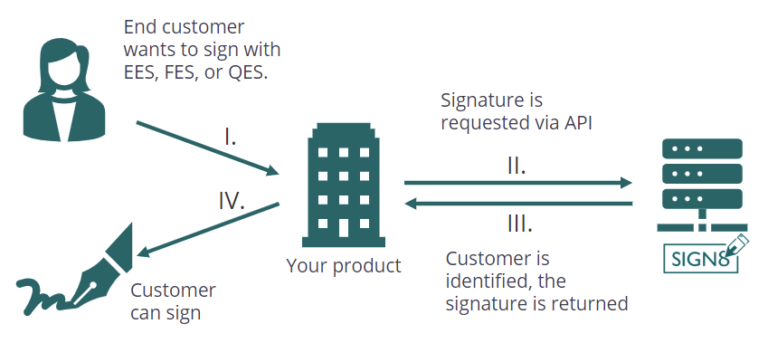
How does TSP as a Service work?
TSP as a Service enables the integration of SIGN8 trust services into customers’ own products, platforms and systems. This allows end users to sign or seal documents directly within the relevant application, whilst processing takes place in the background via the SIGN8 infrastructure.
This saves companies time, reduces technical complexity and minimises regulatory burdens, as they do not need to set up their own complete trust services infrastructure.
Find out more about the CSC API in the podcast
FAQ on the Signature API
What is a signature API?
A signature API is a technical interface that enables electronic signatures and digital seals to be integrated directly into existing systems, platforms or applications. This allows signature processes to be automated and incorporated into digital workflows without any disruption. The SIGN8 Signature API supports, amongst other things, qualified electronic signatures, electronic seals and flexible signature workflows via the Workflow API or CSC API.
Can a QES be integrated via the Signature API?
Yes, qualified electronic signatures (QES) can be integrated into existing digital processes via the Signature API. This enables legally compliant signature workflows to be implemented directly within a company’s own applications, platforms or portals. Companies can thus carry out digital contract signings, approvals or other processes requiring a signature without any disruption to the workflow.
Can electronic seals be integrated via an API?
Yes, electronic seals can be integrated into digital processes via the SIGN8 Signature API. This enables documents to be automatically provided with digital proof of origin. This is particularly relevant for companies, platforms or public bodies that issue, secure or process large volumes of documents and wish to verify their origin and integrity.
What is the difference between the Workflow API and the CSC API?
The Workflow API is designed to enable the rapid integration of workflow-based signature processes. It allows users to utilise and customise predefined workflows and is particularly well-suited to PDF-based signature processes. The CSC API is based on the standards of the Cloud Signature Consortium and offers greater flexibility when it comes to customising signature workflows, bulk signatures and processes that are independent of file format.
What is the CSC API suitable for?
The CSC API is suitable for customised and flexible signing processes based on the Cloud Signature Consortium standard. It offers complete freedom to define your own signing workflows and can be deeply integrated into existing system and process logic. Among other things, the CSC API supports white labelling, bulk signing and a wide range of use cases, regardless of the document file format.
Does the Signature API support bulk signatures?
Yes, the CSC API can also be used to implement scenarios such as bulk signing. This is particularly relevant when a large number of documents need to be signed or sealed automatically or within a short timeframe. Such processes are suitable, for example, for platforms, administrative processes, certificates, supporting documents, contractual documents or other document-intensive business workflows.
Is the SIGN8 Signature API compliant with eIDAS and ZertES?
The SIGN8 Signature API enables the integration of electronic signatures and seals within the context of eIDAS- and ZertES-compliant trust services. Depending on the use case, qualified electronic signatures, electronic seals and other trust services can be integrated into existing digital processes.
This enables signature and seal processes to be implemented with a high degree of legal certainty – both for use cases within the European legal framework under eIDAS and for requirements in Switzerland under ZertES.
What meas TSP as a Service?
TSP as a Service means that trust services can be integrated into a company’s own products, platforms or systems via a technical interface. This means that companies do not need to set up their own complete trust services infrastructure. The Signature API makes it possible to provide functions such as electronic signatures, QES or electronic seals directly within a company’s own application.