
The EU-wide rollout of the EUDI Wallet is often discussed as a digital wallet for citizens, but for the German economy, it is a strategic infrastructure project with transformative potential—driven by the federal government and initiatives such as SPRIND (Federal Agency for Breakthrough Innovations). As part of the modernization of the state, it is fundamentally changing how digital identities are verified, certificates are issued, and business processes are designed. This article explains how companies can harness the benefits of the EU-wide wallet solution—from implementation to increasing acceptance among users and citizens.
eIDAS 2.0 is the next iteration of the European framework for electronic identification and trust services (eIDAS 1.0). The previous eIDAS Regulation has already laid important groundwork for electronic signatures, electronic seals, time stamps, certificates, and trust services. With eIDAS 2.0, this framework is being expanded and more strongly focused on digital identities and interoperable digital credentials.
A key component is the EUDI wallet. It is designed to enable citizens, businesses, and organizations to securely use digital identity data and credentials within the European Union. This creates a European framework in which identities and attributes are not only stored digitally but can also be presented and verified in a trustworthy manner.
It’s important to note that a wallet is not the same thing as a digital document archive. It’s not just about storing information in an app. What matters is that credentials come from trusted sources, that their integrity can be verified, and that receiving entities can reliably validate them. This is precisely where wallets, verifiable credentials, and trust services converge.
For organizations, this primarily changes their perspective. Digital credentials are no longer viewed merely as PDFs, scans, or uploads, but as verifiable components of digital processes. Electronic signatures, electronic seals, certificates, and timestamps can serve as important anchors of trust because they ensure the origin, integrity, timing, and binding nature of digital transactions.
Why eIDAS 2.0 readiness is becoming relevant now
Many details regarding technical standards, national implementations, and specific use cases are evolving gradually. Nevertheless, it makes sense to start addressing eIDAS 2.0 readiness now. The reason is simple: The affected processes are usually deeply integrated into existing systems.
Digital identity and verification processes impact portals, specialized procedures, and DMS, ECM, ERP, HR, IAM, and compliance systems. They affect data models, interfaces, permissions, archiving, audit trails, security architectures, and operational processes. Such structures cannot be adapted quickly or without strategic planning.
Those who wait to address eIDAS 2.0 only when specific implementation deadlines or market requirements are imminent risk ending up with siloed solutions. In such cases, wallet functions, signature processes, or verification checks may be added on an ad hoc basis without fitting neatly into the overall architecture. This can become costly later on, especially if scaling, monitoring, validation, data protection, or multi-tenancy must be added retroactively.
That is precisely why eIDAS 2.0 readiness should not be viewed as merely a legal or compliance project, but rather as a strategic infrastructure issue affecting processes, architecture, and operations. The goal is not to provide definitive answers to every regulatory detail today. Rather, it is crucial to identify relevant processes, clarify responsibilities, and plan the technical foundations so that they can scale to meet future requirements.
Which organizations are particularly affected?
eIDAS 2.0 will be particularly relevant for organizations that already work with
- digital identities
- electronic signatures
- authorizations
- certificates, or
- credentials.
This includes companies as well as government agencies, platform providers, software manufacturers, and IT service providers.
For companies, touchpoints arise wherever individuals, organizations, or authorizations must be reliably verified. This can occur during customer onboarding, supplier vetting, contract processes, compliance verification, or internal approvals. In regulated industries such as banking, insurance, healthcare, energy, KRITIS, or manufacturing, the relevance is particularly high because traceability, security, and auditability are already key requirements today.
Government agencies and public institutions are also significantly affected. For them, eIDAS 2.0 can be a key component in making administrative services more digital and trustworthy. Digital notices, registry extracts, permits, certificates, or other forms of verification must not only be provided electronically; they must also be unambiguously issued, verifiable, and traceable over the long term.
For platform and software providers, another question arises: How can wallet, signature, seal, or proof functions be integrated into their own products? This applies in particular to providers of SaaS solutions, as well as DMS, ECM, ERP, HR, or industry-specific process software. If digital proofs are to be embedded directly into platform processes in the future, interfaces, role models, and trust service connections must be considered early on.
IT service providers, data centers, and managed service providers should also keep an eye on eIDAS 2.0. If they operate trust services, identity infrastructure, or wallet-related services for customers, issues such as multi-tenancy, operational security, SLAs, monitoring, scalability, and operating models will become critical.
Which processes should be reviewed?
A good readiness approach does not start with technology, but with processes. Organizations should first understand where identities, authorizations, or credentials are relevant today and how these processes could be digitally mapped in a trustworthy manner in the future.
Typical examples include digital identification, customer or supplier onboarding, electronic contract execution, internal approvals, electronic signatures, and the sealing of organizational documents. Digital notices, registry extracts, certificates, proof of qualifications, and proof of compliance may also be relevant.
In practice, it is particularly worthwhile to examine processes that are still heavily paper-based today or rely on PDFs, scans, email attachments, and manual checks. While such processes often work, they are frequently difficult to scale, prone to errors, and can only be automated to a limited extent. When proof must be verified manually or a document must be compared by hand, a media discontinuity occurs. eIDAS 2.0 and wallet-based proofs can open up new possibilities here, provided the underlying infrastructure is in place.
Equally important are processes related to certificates, key management, validation, revocation checks, archiving, and auditing. These topics are less visible than a wallet interface, but they determine whether digital processes remain truly trustworthy and traceable.
What roles do the EUDI Wallet and Verifiable Credentials play?
The EUDI Wallet is designed to enable the use of digital identities and credentials within the European Union. In simple terms, it can be understood as a secure digital interface where users can store certain identity data and credentials and present them as needed.
The Business Wallet also plays an important role in this context. It extends the wallet concept to organizations and, in the future, can help make corporate identities, powers of representation, certificates, and regulatory credentials digitally accessible. This is particularly relevant for companies, platforms, and government agencies when it is necessary to verify not only a person’s identity but also their role within an organization or the trustworthiness of a company.
Verifiable credentials complement this concept. They are verifiable digital credentials whose origin and integrity can be technically validated. Such a credential is therefore not simply a file, but contains a trust framework: Who issued it? Has it been altered? Is it still valid? May it be used for the specific purpose?
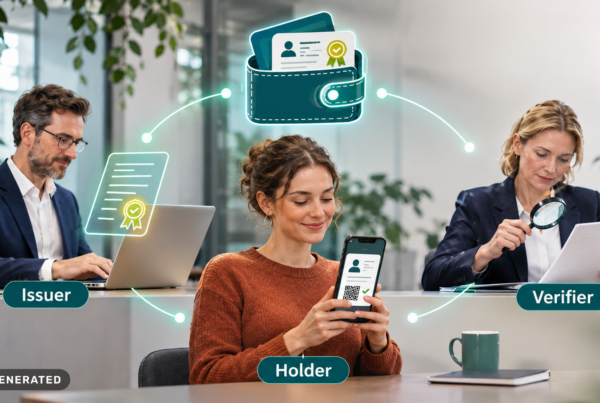
For organizations, the key factor is the role they play in this ecosystem. Some organizations will issue credentials—such as government agencies, educational institutions, or companies with specific authorization or qualification processes. Others will verify credentials—for example, banks, platforms, employers, or public agencies. Still others must hold credentials themselves and present them to third parties.
These roles are often described as issuer, holder, and verifier. The issuer issues a credential, the holder manages it, and the verifier verifies it. In practice, organizations can assume multiple roles simultaneously. For example, a company can verify its employees’ qualifications, present its own organizational credentials, and at the same time issue specific authorizations for partners or customers.
“Wallet readiness” therefore means more than just technically integrating an EUDI wallet into processes and systems. It means designing issuance, verification, and management processes in such a way that they are trustworthy, secure, and integrable. Electronic signatures, electronic seals, certificates, and timestamps can support this because they link digital transactions to verifiable trust features.
By the way, you can find more information about Verifiable Credentials in our blog post:
Which trust service infrastructure will become relevant?
The more digital identities and credentials are integrated into business and administrative processes, the more important the underlying trust service infrastructure becomes. A wallet interface alone is not enough. Organizations need technical and organizational components that can securely execute, verify, log, and scale digital processes.
These include electronic signatures and seals, as well as certificates, timestamps, PKI and CA components, certificate management, key management, and validation services. Revocation and status checks also play an important role, because not every credential or certificate remains valid indefinitely. It is crucial that systems can reliably determine whether a digital credential is trustworthy at the time of verification.
APIs are particularly relevant for platforms and specialized procedures. Signature, seal, and validation processes must be able to integrate into existing applications without unnecessarily complicating user workflows. At the same time, audit and logging functions must ensure that relevant processes are documented in a traceable manner.
For CIOs and CTOs, architecture is the primary focus. Trust infrastructure should not be built as an isolated, standalone function, but rather as a scalable foundation for various digital processes. For CISOs, the protection of keys, certificates, and sensitive transactions is crucial. Legal and compliance teams focus on auditability, regulatory requirements, and liability issues. Product owners and platform teams, in turn, require APIs, clear integration paths, and reliable operating models.
In many organizations, the question of the appropriate operating model also becomes central. Depending on security, compliance, and sovereignty requirements, cloud, private cloud, hybrid, or on-premises scenarios may be appropriate. It is important not to make this decision at the very end, but to incorporate it early on in the readiness planning process.
📃 Readiness Checklist: What Should Organizations Be Checking Right Now?
1. Strategy
- Is there an internal point of responsibility for eIDAS 2.0 and wallet readiness?
- Have relevant use cases been prioritized?
- Is this topic incorporated into digital, product, or compliance roadmaps?
2. Processes
- Which processes require digital identities or credentials?
- Where are paper documents, PDFs, or manual checks currently used?
- Which processes require signatures, seals, or timestamps?
3. Roles in the Wallet Ecosystem
- Is the organization an issuer, holder, verifier, or platform operator?
- What types of credentials are issued?
- Which credentials are verified?
- Which credentials must the organization manage or provide itself?
4. Systems and Integration
- Which business systems, portals, or platforms need to be integrated?
- Are there suitable APIs?
- How are signature, seal, and validation processes integrated?
- Which data sources are authoritative?
5. Security and Compliance
- Where are keys and certificates protected?
- How are audits documented?
- What audit and documentation requirements exist?
- What data protection requirements apply?
6. Operations and Scaling
- What volumes can be expected?
- What SLAs are required?
- Is multi-tenancy required?
- Which operating model is appropriate: cloud, private cloud, hybrid, or on-premises?
Common mistakes when preparing for eIDAS 2.0
A common mistake is to view eIDAS 2.0 exclusively as a compliance issue. Of course, regulatory requirements are important. But if the topic is framed solely in legal terms, key architectural and process questions often remain unanswered for too long.
It is equally risky to reduce wallet readiness to a single interface. A wallet connection may seem relatively straightforward from a technical standpoint. However, the real complexity often lies beneath the surface: Which data is relevant? Who is authorized to issue credentials? How are they verified? How are revocations and status information handled? How is it documented that a credential was valid at the time of verification?
Existing signature and seal processes should not be viewed in isolation either. Many organizations already use electronic signatures, certificates, or seals, but these are not always prepared for future wallet and credential processes. If such components are developed separately, it can lead to media discontinuities and duplicate infrastructures.
Another common mistake is planning for operations and scaling too late. Individual pilot projects can often be implemented quickly. Things become more difficult when high volumes, multiple clients, strict SLAs, monitoring, audit requirements, or different operational environments come into play. Therefore, eIDAS 2.0 readiness should be understood from the outset as an operational and scaling issue as well.
How SIGN8 Can Help You
In the context of eIDAS 2.0 and wallet readiness, this involves not only individual functions but also the reliable integration of trust services, APIs, PKI and CA components, certificate management, validation, and scalable operating models. Depending on requirements, private cloud, hybrid, or on-premises scenarios may be relevant.
For companies, government agencies, and platform providers, SIGN8 can thus serve as an infrastructure partner to implement eIDAS- and wallet-oriented processes in practice: securely, with integration capabilities, and with an eye toward future digital verification processes.
Conclusion
eIDAS 2.0 will more closely integrate digital identities, credentials, and trust services. For businesses, government agencies, and platform providers, this creates a new strategic arena that goes well beyond the introduction of a digital wallet.
It is crucial to assess early on which processes require digital identities, which credentials need to be issued or verified, which systems must be integrated, and what trust service infrastructure is required to support these efforts. Those who take a structured approach to eIDAS 2.0 readiness will not only ensure regulatory compliance but also lay the foundation for digital processes that are trustworthy, scalable, and interoperable.