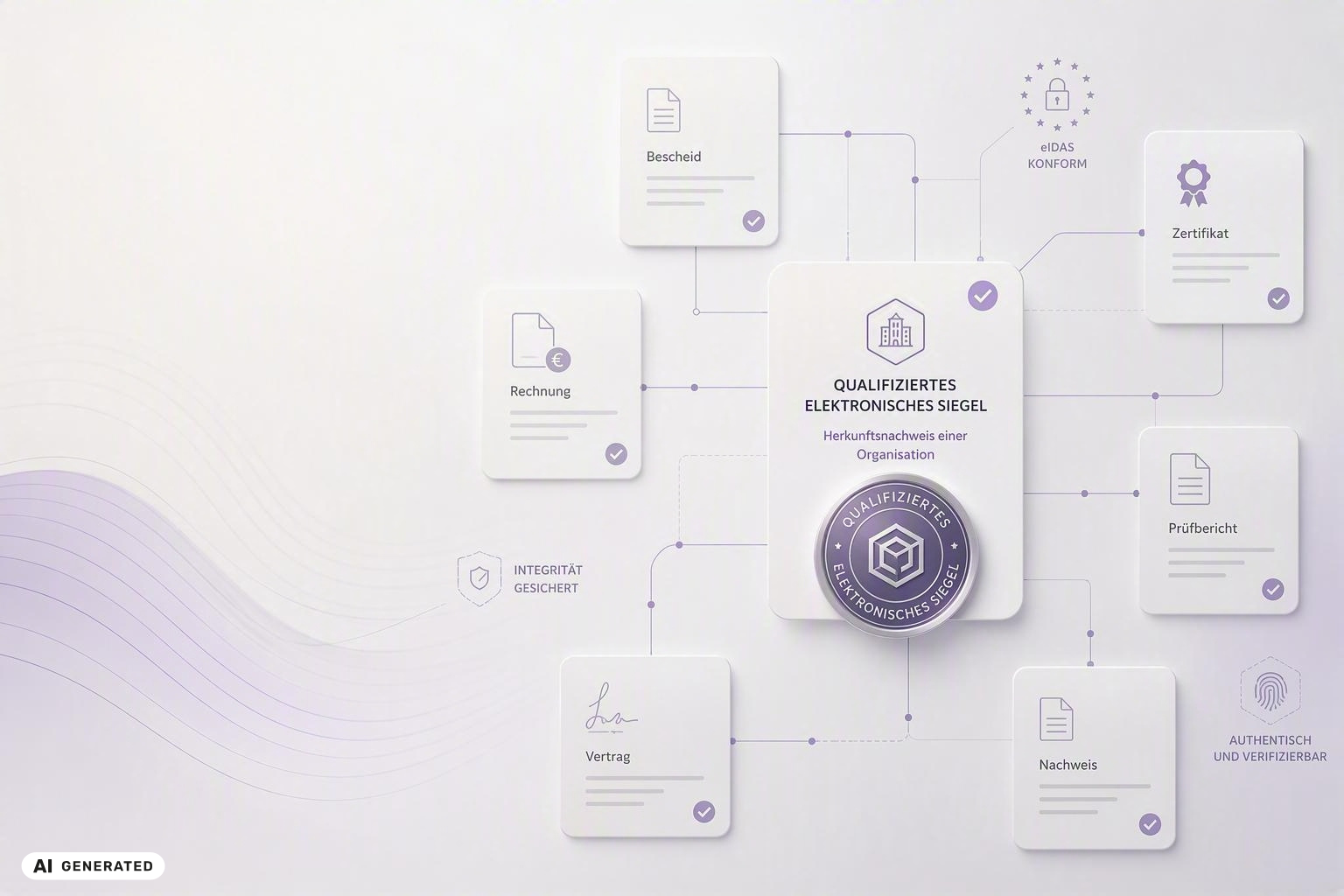
A qualified electronic seal is the digital equivalent of a company stamp or corporate seal for businesses. For public authorities, it is the digital equivalent of an official authority seal. It confirms that a document originates from a specific organization and has not been altered since it was sealed. This is particularly relevant for legal, operations, public administration and compliance when invoices, official notices, certificates, evidence or bank statements are to be created, verified and electronically sealed in a legally secure manner.
Importantly, a seal does not automatically replace a signature. Its primary purpose is not to express the personal intent of an individual, but to establish authenticity, proof of origin, integrity and the unaltered state of a document. This is precisely why qualified electronic seals play an important role in the digitalization of trustworthy business and public-sector processes.
An electronic seal is a trust service under the European eIDAS Regulation. It is used by a legal person, such as a company, public authority or other organization. The seal indicates: This document was issued by this specific organization and has not subsequently been altered.
The qualified electronic seal is the highest level of electronic seal. It is based on a qualified certificate issued by a qualified trust service provider and is created using a secure seal creation device, for example via a seal card or remote seal. This provides a particularly high level of trust for the electronic use of documents.
Signature or seal: What is the difference?
An electronic signature is assigned to a natural person. It enables a person to sign electronically, for example a contract, approval or declaration.
An electronic seal, on the other hand, belongs to an organization. The distinction is therefore fundamental: It is not “John Doe” signing personally; instead, the company digitally confirms the origin and integrity of the document. In practice, this is more comparable to a digital company stamp than to a personal signature.
Importantly, companies can both sign and seal documents. This can be useful, for example, when a responsible person makes a declaration and the organization additionally confirms the authenticity of the document.
Types of electronic seals under eIDAS and the legal framework
The eIDAS Regulation distinguishes between two types of electronic seals:
– Advanced electronic seal: is uniquely linked to the organization and connected to the document in a tamper-resistant manner.
– Qualified electronic seal: provides the highest level of evidentiary value and requires a qualified certificate and a qualified technical environment.
The key legal bases for electronic seals include the eIDAS Regulation and, in Germany, the supplementary Trust Services Act. A qualified electronic seal issued in Germany is recognized throughout the EU if it has been issued by a qualified trust service provider on the basis of a qualified certificate. The Trust Services Act further specifies the national framework for trust services and their supervision.
The former German Signature Act is now primarily of historical relevance: The main requirements for electronic signatures, seals and trust services are now derived from eIDAS and the supplementary national regulations.
Particularly important from a legal perspective: A qualified seal benefits from the presumption that the integrity of the data has been preserved and that the origin of the document is correct. This helps preserve the evidentiary value of digital documents and processes. Companies should also take industry-specific requirements, compliance obligations and internal security policies into account.
Benefits of a qualified electronic seal
The main benefits of a qualified electronic seal are security, automation and compliance:
– reliable proof of origin for documents
– protection of integrity and authenticity
– EU-wide recognition under eIDAS
– fewer media disruptions in digital processes
– suitable for high regulatory requirements
– automated sealing of large volumes of documents
– improved traceability in audit and compliance processes
For companies, this means that documents can be provided digitally without sacrificing trust, authenticity or evidentiary value. Particularly when digitalizing specialized processes, the seal becomes an important building block for secure and transparent workflows.
Which documents and processes are electronic seals suitable for?
Qualified electronic seals are particularly suitable for documents that do not require a personal signature but need to be officially confirmed by an organization. Typical applications include:
– invoices and electronic invoice processing
– official notices and communications from public authorities
– certificates, credentials and confirmations of participation
– bank statements and financial records
– EPREL or DPP-related product information
– digital credentials in portals
– scanned documents in the context of preserving evidentiary value, for example with reference to BSI TR-RESISCAN
Particularly in the context of EPREL, regulated products or public administration, a qualified seal can help make digital documents traceable, secure and verifiable. For high-volume processes, such as automatically generated official notices or credentials, remote sealing or bulk sealing is often the more practical solution.
For scanning processes, it is also relevant whether internal procedures are aligned with BSI recommendations and RESISCAN-related requirements. In such scenarios, qualified sealing can help provide additional assurance for the traceability of digitized documents.
Can any company apply for a qualified electronic seal?
Before a qualified electronic seal can be used, it must be applied for. In principle, any legally capable organization can apply for a qualified electronic seal, provided that its identity and representation authority can be verified. This can be done, for example, using an extract from the commercial register or an official confirmation. This includes companies, associations, public authorities, public-law entities and other legal organizations.
Depending on the provider, the following are typically required for a seal application:
– current extract from the commercial register or comparable evidence
– proof of the organization and its address
– proof of identity of an authorized representative
– power of attorney if the application is submitted by an authorized person
– information about the desired seal certificate and intended purpose
The exact process depends on the respective provider and the selected solution.
Seal card or remote seal: Which solution is right?
With a seal card or signature token, the certificate is stored on physical hardware. This can be useful when individual users occasionally need to seal documents.
A remote seal is generally the better solution for higher-volume digital processes. Sealing is performed centrally via a qualified trust service. This makes it easier to integrate sealing into applications, workflows and specialized systems.
For legal and operations teams, the key question is therefore: Are we dealing with individual manual cases or scalable digital processes with regular use? Anyone who wants to automatically sign or seal large volumes of documents should consider technical integration at an early stage.
Visibility, timestamps and validation of electronic seals
A qualified electronic seal can appear visibly in the document, for example as a seal graphic containing the organization’s name, the date or a reference to the certificate. This visible representation may resemble a company stamp. However, the decisive factor is not its appearance but the cryptographic validation.
Electronic seals can be validated using PDF validators, qualified validation services or verification mechanisms that take certificates, timestamps, revocation status and the EU Trusted List into account. A qualified timestamp can additionally help provide reliable evidence of when the seal was applied and strengthen the evidentiary value over the long term. Particularly for long retention periods, a properly integrated timestamp is an important component of technical evidence.
Frequently asked questions about qualified electronic seals
Is an electronic seal legally valid in Germany?
Yes. Electronic seals are legally recognized under eIDAS. Qualified electronic seals benefit from a particularly strong legal presumption throughout the EU.
Does a qualified electronic seal replace a signature?
No. A seal confirms the origin of a document from an organization. A signature, on the other hand, confirms an action or declaration by a natural person.
Can a document be signed and sealed at the same time?
Yes. A document can contain electronic signatures as well as an electronic seal, for example when a person signs it and the company additionally confirms its origin.
Is a visible seal image sufficient?
No. The visible image is only a representation. It may look like a digital company stamp, but the electronic certificate, the security of the technical creation process and the validation of the seal are what matter from a legal perspective.
How does SIGN8 support organizations with seal applications?
SIGN8 supports companies and public authorities in assessing their requirements, selecting suitable seal solutions, completing the application process and implementing trustworthy digital processes in practice.
Conclusion
A qualified electronic seal creates trust in digital documents. It confirms their origin, strengthens authenticity, protects integrity and helps companies meet legal and organizational requirements under eIDAS. It is particularly valuable where documents are processed automatically, in large volumes or with high evidentiary requirements.
SIGN8 supports organizations in the areas of trust infrastructure, trust services, digital identities, electronic signatures and EUDI Wallet Readiness – helping them implement seals, credentials and digital processes in a practical and compliance-ready manner.