Digital signatures are on the rise in Switzerland – yet many companies are still hesitant. Why? Because persistent myths continue to circulate, fuelling uncertainty. Yet qualified electronic signatures (QES) under the ZertES are not only legally secure, but also more efficient and cost-effective than paper-based processes. In this article, we dispel the five most common misconceptions and show why digital signatures are no longer just a ‘nice-to-have’, but a ‘must-have’ for forward-thinking businesses.
Why you should read this article:
– Many companies confuse simple (FES), advanced (FES) and qualified electronic signatures (QES).
– Switzerland has its own standard, ZertES – we explain what this means for you in practical terms.
– Compliance, security and practicality are often misjudged.
Let’s start with the first myth – and probably the most widespread one.
Myth 1: “Digital signatures are not legally binding in Switzerland.”
In many companies, there is still a widespread belief that only handwritten signatures are valid in Switzerland. However, this is a misconception.
On 18 March 2016, the Federal Act on Electronic Signatures, known as ZertES for short, was passed in Switzerland. It provides as follows:
– Quality requirements for digital certificates and their use
– Requirements for organisations wishing to act as recognised providers of electronic signatures and other certification services
– Rights and obligations of these recognised providers
The ZertES has a number of objectives:
– Promoting a wide range of secure certification services
– Encouraging the use of certification services
– Facilitating the international recognition of certification service providers and their services
Switzerland distinguishes between four types of electronic signatures:
– Simple electronic signature (EES): The EES is the lowest level of electronic signatures and does not meet any specific security requirements. It can be compared to a scanned signature.
– Advanced electronic signature (AES): The AES offers a higher level of security than the EES, as a second factor – such as a text message or a phone call – ensures that a person can be uniquely identified.
– Regulated electronic signature (GES): The GES is a specific type of advanced electronic signature created using a secure signature creation device.
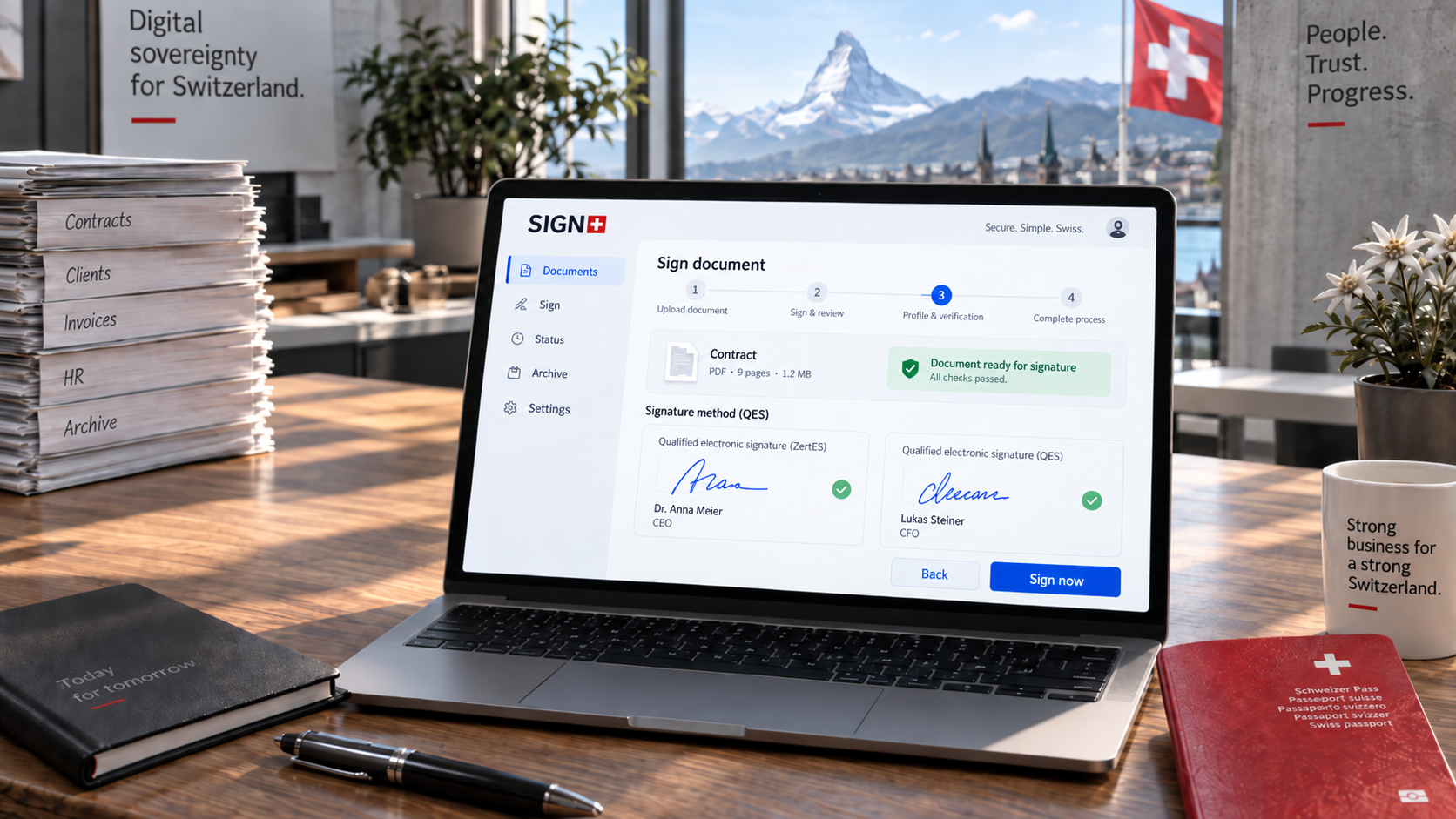
– Qualified electronic signature (QES): The QES is the highest level and is equivalent to a handwritten signature.
This principle of equality is set out in Article 14(2bis) of the Swiss Code of Obligations (CO):
“A qualified electronic signature linked to a qualified time stamp, as defined in the Federal Act of 18 March 2016 on Electronic Signatures, is deemed equivalent to a handwritten signature. This is subject to any deviating statutory or contractual provisions.”
A common example of this is a loan agreement. If it is signed using a QES, it is just as legally binding as a paper document signed by hand and can be used as full evidence in court.
So the next time you find yourself wondering whether a QES is sufficient for your business, remember this article: for over 95 per cent of all contracts, a QES is the legally secure and efficient solution. Exceptions, such as wills or property purchases, which still require notarisation, are rare. If you have any doubts, it is worth taking a moment to check your specific circumstances.
Incidentally, there is also an EU equivalent to the ZertES: the eIDAS Regulation. The eIDAS Regulation is also legally valid in Switzerland, which means that QES must be recognised as legally valid throughout the EU.
Myth 2: “Qualified signatures are too complicated and expensive.”
Many companies are put off by digital signatures because they fear high costs and technical complexity. But the reality is quite different.
When it comes to costs, a simple calculation can be made: imagine the process involved in an employment contract – this must be signed by at least the applicant and the HR department. The paper-based process involves printing, posting, signing, returning the documents, and manually checking that all signatures are present. This can easily amount to CHF 10–20 per document.
If the employment contract is signed electronically, these steps are no longer required: all recipients of the document are prompted to provide an electronic signature directly from the signature portal and go through a predefined process, including identification. All parties to the contract are notified within a few seconds that the document has been signed and can download the signed employment contract. Depending on the volume of signatures, you can expect costs of between CHF 0.50 and 2 per signature.
If you compare the costs of the paper-based process with those of the digital process, the cost argument quickly loses its significance.
The concern that electronic signatures involve a great deal of technical effort can also be easily refuted.
Modern APIs enable integration into existing systems such as CRM, DMS or online banking within just 2–4 weeks, depending on the developer’s expertise. Integrating an electronic signature directly into the process – also known as embedded signing – avoids media breaks, improves the customer experience and minimises abandonment rates.
Another argument in favour of electronic signatures is their high scalability. Documents can be signed digitally regardless of location or time – ideal for companies operating internationally.
To put an end to this myth once and for all, we would like to give a brief example: by switching to digital signatures, a Swiss bank was able to reduce the time taken to open an account from 5 to 2 days, whilst cutting costs by 70 per cent.
Of course, the initial set-up costs money, but the long-term savings far outweigh them.
Myth 3: “Only large companies need digital signatures.”
Many SMEs think that digital signatures are only for large corporations. Yet they offer enormous benefits, particularly for small and medium-sized enterprises.
This myth, too, can easily be debunked, as compliance affects everyone. Regulations such as FATCA, CRS and the GDPR, as well as sector-specific standards, must be adhered to by all types of business. Digital signatures help in this regard by simplifying the process of providing evidence and minimising liability risks.
Digital, seamless processes are no longer just a ‘nice-to-have’ for customers, but an important deciding factor, particularly in the B2B sector.
Customers compare not only products but also processes, and choose providers who demonstrate digital maturity. In Switzerland, over 60 per cent of businesses already use digital signatures, and this figure is rising sharply. Those who fail to keep up risk being perceived as outdated.
Here, too, we would like to provide a practical example to illustrate the point: a Swiss HR tech start-up used digital employment contracts to reduce the contract processing time from 5 to 1 day, thereby increasing its customer acquisition by 30 per cent within a few months. The game-changer: candidates were able to sign contracts immediately and from anywhere, rather than having to wait for them to arrive by post.
Incidentally: As electronic signatures grow alongside the business, the HR tech start-up has had no problems even as order volumes have increased – the signing process continues to run smoothly and efficiently.
Myth 4: “Digital signatures are insecure and prone to fraud.”
Security is the main concern for many businesses. However, qualified electronic signatures are more secure than handwritten signatures when used correctly.
Your security is based on three key pillars: technology, verifiability and monitoring.
Technology:
QES are based on encrypted certificates, which must meet the highest security standards, such as ETSI standards or ISO 27001. Only certain providers, known as certification service providers, are authorised to issue certificates for a QES. These providers must undergo regular, independent audits to ensure compliance with the strict security standards. It should also be borne in mind that every QES can be uniquely attributed to a signatory and that cryptographic methods ensure that the signature cannot be tampered with.
Traceability:
Anyone who uses digital signatures benefits from a complete audit trail. This means that every QES generates audit-proof evidence that records the following data:
– Who signed it? (Identity verified via certificate, e.g. SwissID or Video-Ident)
– When was it signed? (Timestamp in UTC, tamper-proof)
– What has been signed? (Document hash, which detects even the smallest changes)
– Where was it signed? (IP address, device ID – optional)
A real-life example: A Swiss financial services firm uses QES for loan agreements. During an internal audit, it emerged that a customer claimed never to have signed an agreement. However, the audit trail showed that:
– The document was signed on 12 May 2024 at 2.32 pm (timestamp).
– Identity was verified via SwissID using two-factor authentication.
– The document hash proved that no subsequent changes had been made.
The matter was resolved within a few minutes – without the need for an expert opinion. Had the customer signed the contract by hand and returned it by post, there would have been neither a timestamp, nor any means of identification, nor even a hash – but instead a protracted dispute!
Control
Do you think simple e-signature tools, such as those used via email, are insecure? You’re not entirely wrong. However, qualified electronic signatures in accordance with ZertES offer maximum protection and control. ZertES-compliant signature solutions are subject to strict requirements regarding the handling of identity and certificate data. For you, this means that sensitive data remains protected and you retain control over identities and certificates.
Myth 5: “Digital signatures are no substitute for physical stamps or seals.”
Many companies believe that digital signatures cannot replace legally binding stamps or seals. But that, too, is a myth.
In addition to the types of signature already described, the Swiss Digital Signatures Act also defines a seal: the regulated electronic seal. Unlike signatures, there is only one form of seal.
From a legal perspective, a regulated electronic seal has the same legal effect as a physical stamp. It can therefore be used without hesitation for compliance documents, invoices or official notices. The key difference between a signature and a seal lies in the user group:
– Signatures are issued to natural persons
– Seals are issued to legal entities
In practice, the breakdown might look like this: a Swiss bank uses the regulated electronic seal for FATCA/CRS reports and the qualified electronic signature for loan agreements with retail customers. With the right solution, both services can even be conveniently accessed from a single source.
Our take on the 5 myths
Qualified electronic signatures are legally secure, cost-effective, scalable and more secure than paper. The five myths we have debunked are holding many companies back from adopting digital processes. Yet they have long been standard practice in the Swiss business world.
Whether in banking, insurance or LegalTech: digital signatures offer clear advantages
✅ Legal certainty (ZertES & eIDAS)
✅ Cost savings (up to 70% reduction in process costs)
✅ Increased efficiency (real-time signatures)
✅ Future-proof (ready for the EUDI wallet & eIDAS 2.0)