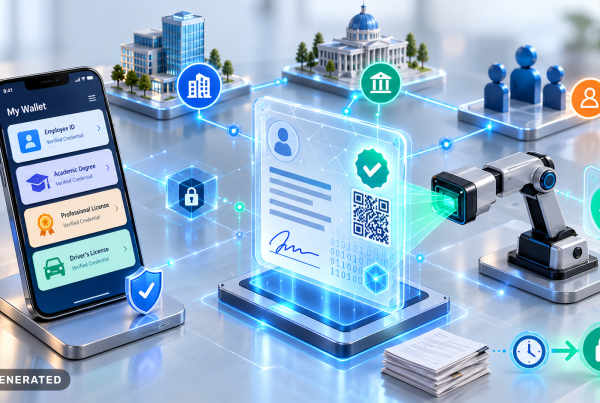
In Germany, a digital ID is often associated with the national identity card and its online ID function. In the context of the EUDI Wallet, however, the term is broader: it refers to digitally usable and technically verifiable credentials relating to the identity, attributes, roles or authorizations of a person or a company.
For organizations, the question is therefore not only how citizens can identify themselves online or apply for services online. They need to clarify which credentials they want to issue, verify, accept or integrate into their processes in the future. The wallet provides the framework for this. What matters are the data it contains, their origin and the required level of trust.
With eIDAS 2.0 and the wallet, a new identity ecosystem for private and public applications is emerging in the EU. Companies and authorities can integrate confirmed data, i.e. credentials, directly into digital processes and online services. Instead of requesting documents as scans or by post, identity and attribute credentials can be verified automatically via the wallet.
This affects banks, insurance companies, universities, employers and the administration of the federal government, federal states and municipalities, for example. In Germany, this means that not only companies, but also the federal government, the federal states and municipalities must address their future role in the wallet ecosystem.
Digital administrative procedures can also become simpler if citizens provide the required credentials directly from their wallet. In particular, administrative procedures that currently start online but are interrupted by additional certificates sent by post or as scans could become fully digital as a result.
What is a digital ID?
A digital ID is an electronic proof of identity whose origin, integrity and validity can be technically verified. It can confirm a complete identity or contain individual attributes, such as age, qualification, employment status, role or power of representation.
So it is not just about a digitally displayed national identity card. A university degree, proof of employment, a certificate or a power of attorney can also exist as a digital credential. For organizations, it is therefore not only important which information a digital credential contains. They must also verify who issued it, whether the issuer is trustworthy for this type of credential, and whether origin, validity and possible revocation can be technically checked.
Which level of trust is required depends on the respective workflow: a simple age confirmation has different requirements than customer onboarding at a bank, a power of representation or a legally relevant contract conclusion.
The online ID function as a familiar form of eID
The eID of the German national identity card is already an electronic proof of identity today. The online ID function enables identification with an online service. To use the ID function, a national identity card with the ID function activated, a personal six-digit PIN and usually the AusweisApp are required.
The AusweisApp reads the card via an NFC-enabled smartphone. Alternatively, a card reader can be used as a reading device. The eID card for citizens from other EU countries and the electronic residence permit, or eAT for short, can also contain an online ID function. The function of the national identity card and the function in the residence permit follow the same basic idea: confirmed identity data is transmitted electronically.
If the ID function has not yet been activated or a new PIN is required, the responsible authority or citizens’ office is the right point of contact. Questions about activating the eID, the AusweisApp or the card can also be clarified there. Anyone wishing to apply for a national identity card, an eID card or an electronic residence permit in Germany should contact the respective responsible office. Depending on the document, individual steps can already be prepared online.
However, the eID and its online ID function should not be equated with the wallet. The ID function of the national identity card or residence permit transmits state-confirmed identity data. The wallet can additionally manage credentials from various issuers and provide them for different applications. For organizations, the physical card is therefore less important than the secure integration of the data into their processes.
Digital ID and wallet: What is the difference?
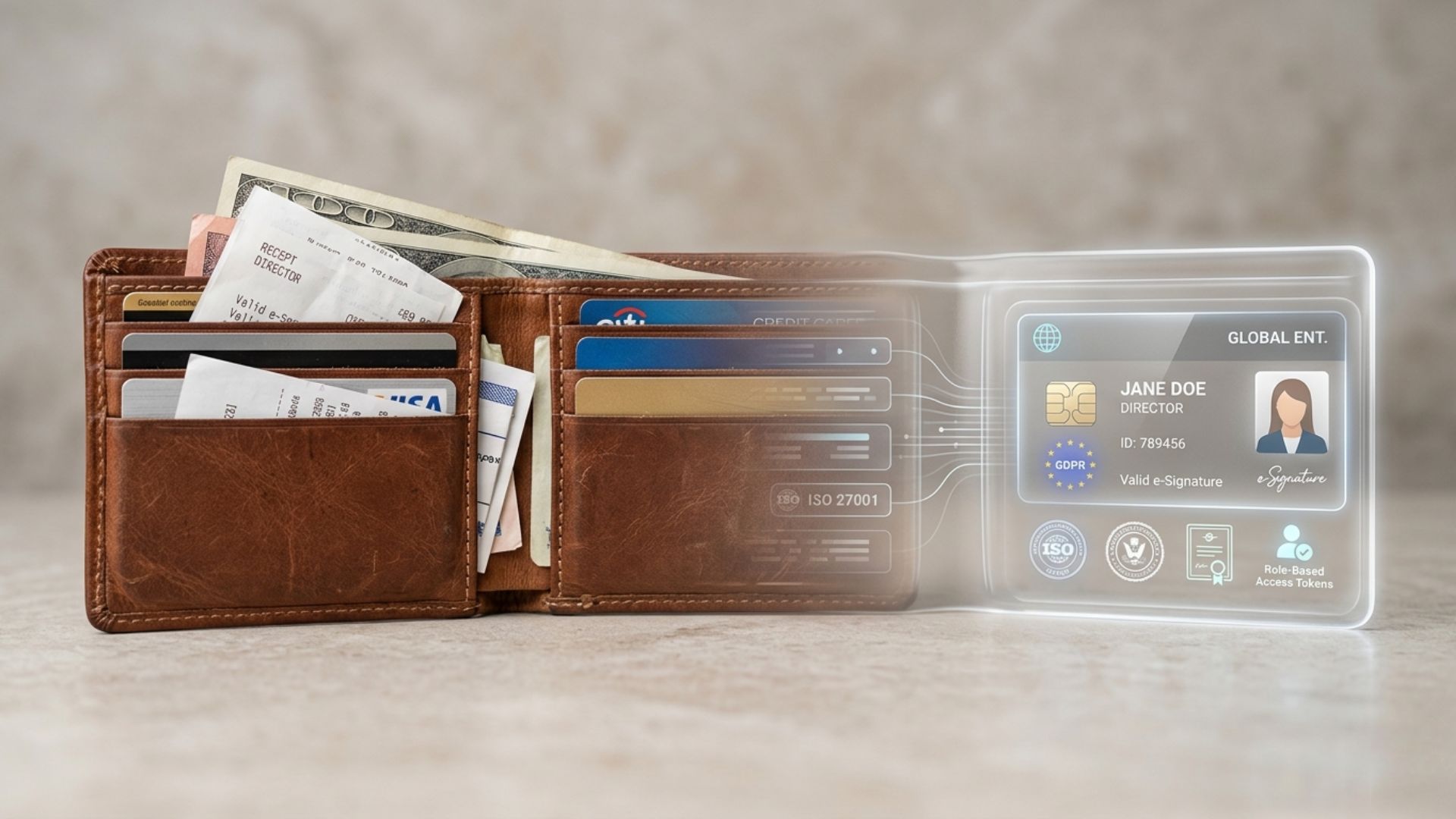
The comparison with a physical wallet helps: the wallet is the environment, while the digital ID is one of its possible contents. In addition to identity data, the wallet can store and selectively provide further documents and proofs.
The receiving party, for example a company, must be able to verify who issued a credential, whether it is still valid and whether its level of trust is sufficient. A revocation or the cancellation of an authorization must also be recognizable.
For an age check, for example, the confirmation “over 18” may be sufficient. The full date of birth does not have to be transmitted. This enables data-minimizing use of digital identities.
Which roles can companies take in the EUDI Wallet ecosystem?
Companies can take on different roles in the wallet ecosystem. Which of these is relevant depends on which data and credentials are needed in their own processes and whether the company issues, verifies or technically processes them itself.
Issuer
As an issuer, the company issues a digital credential and transmits it to the wallet of the respective person or organization. This credential can confirm, for example, a professional qualification, employment relationship, membership, role or specific authorization.
An employer could issue a digital proof of employment, for instance. A university could provide a degree or enrollment status. A company could also confirm that a person is authorized to act on behalf of the organization.
For the recipient, it must be clear who issued the credential, whether it is unchanged and whether it is still valid. Depending on the type, different requirements also apply to the issuer and the required level of trust.
Relying Party / Verifier
A relying party requests a digital credential or selected data from the wallet. It relies on the transmitted information in the subsequent process and must therefore verify its origin, validity and level of trust.
For example, a company can request proof of identity during online onboarding, only the information “over 18” for an age check, or a power of representation for a business transaction.
It is important that not all available data is automatically requested. Companies should request only the information they actually need for the respective purpose. In addition, they must define which issuers are accepted and how expiry and revocation are handled. This approach follows the principle of data minimization and is also referred to in the wallet context as selective disclosure.
Service Provider / Integrator
Service providers and integrators create the technical connection between the wallet and an organization’s existing systems. They integrate wallet functions into customer portals, apps, online onboarding flows or specialist procedures, for example.
This includes enabling a system to request, receive and technically verify credentials from a wallet. The confirmed data must then be transferred meaningfully into the respective business process.
The challenge often does not lie solely in the wallet interface. Existing systems, responsibilities, verification rules and follow-up tasks must also be adapted. An integrator therefore ensures that the wallet is not treated as an isolated solution, but fits into the existing IT and process landscape.
Wallet Provider
A wallet provider supplies the actual wallet solution. It is responsible for ensuring that users can securely receive, store, manage and present their digital credentials to a service.
Among other things, the wallet must ensure that users retain control over their data and can understand which information is transmitted to whom. At the same time, the solution must meet the applicable technical, organizational and regulatory requirements.
Providing one’s own wallet is therefore significantly more complex than merely accepting credentials from a wallet. For most organizations, the role of issuer, verifier or integrator will initially be more relevant.
Users of trust services
Organizations can additionally connect wallet processes with trust services. These include, for example, electronic signatures, electronic seals and timestamps.
Proof of identity alone, for example, does not automatically replace an electronic signature. If an identified person is subsequently to sign a contract in a legally secure manner, an advanced or qualified electronic signature may additionally be required.
Electronic seals, in turn, can confirm the origin and integrity of documents or company data. Timestamps prove that certain data existed at a defined point in time.
For organizations, this means: wallet, digital credentials and trust services should not be considered separately. Only their interaction enables fully digital workflows — from identification and verification of an authorization through to legally valid signing or sealing.
Which digital credentials are relevant for organizations?
This depends strongly on the respective process and on the organization’s own role in the wallet ecosystem. In KYC or onboarding, for example, identity data, age or place of residence may be relevant. In HR, the focus is more on qualifications, certificates, proof of employment or specific roles. In business transactions, by contrast, organizational data, powers of attorney and power of representation often play an important role.
A digital ID can bundle different information or provide specific individual data. Organizations can verify these credentials, issue them themselves or integrate them into existing applications. Processes can additionally be connected with electronic signatures and seals. For example, after identity or authorization verification, a contract can be signed electronically or the origin of a document can be confirmed by an electronic seal.
The main advantage lies in end-to-end digital processes: data does not have to be entered multiple times, documents do not have to be sent as scans or by post, and credentials do not have to be manually checked again for every process. At the same time, origin, validity and integrity can be technically verified, making forged documents and identity theft more difficult.
Wallet readiness: What companies should clarify now
Organizations should first examine:
- Which data and documents do we request today?
- Which of these could be available as digital credentials in the future?
- Do we want to issue, verify or technically integrate credentials?
- Which level of trust is required?
- Which systems, interfaces and trust services need to be connected?
- How do we address data protection, revocation and responsibilities?
The right time to get started depends on the use case. A pilot project is possible in online onboarding, for a qualification or for a power of representation. The integration can then be expanded to further workflows or countries
Conclusion: Credentials create the practical value
In the EUDI Wallet ecosystem, digital ID is more than an electronic version of the national identity card. It can represent identity data, qualifications, roles and authorizations. Companies should therefore clarify which credentials they need, which providers they accept and how they integrate verification into their processes.
We support companies and public authorities with wallet readiness and the implementation of trustworthy digital identity processes. This includes electronic signatures and seals, qualified credentials and the necessary trust infrastructure.
FAQ on digital ID
How can you apply for a digital ID?
That depends on the credential. Anyone wishing to apply for a national identity card, an eID card or an electronic residence permit in Germany should contact the responsible government office. Other digital credentials can be issued by authorities, universities, employers or authorized providers. In the future, such credentials may be provided directly online and stored in the wallet.
Is the wallet itself an ID?
No. The wallet is the technical environment in which a digital ID and other credentials can be stored, managed and shared.
Does every organization have to offer its own wallet?
No. They can participate as issuers, verifiers, integrators or users of trust services.
Which applications are particularly relevant?
These include KYC, online onboarding, age verification, qualification credentials, access rights, powers of representation, digital administrative procedures and contract conclusions.